Yet collecting more data does not automatically create better decisions.
Across many organizations, valuable information remains distributed across disconnected applications, legacy databases, control systems and facility-level platforms. Different assets may use inconsistent data structures, equipment identifiers and integration standards, making it difficult to establish a reliable enterprise-wide view of operations.
This is where industrial data infrastructure becomes critical.
A modern industrial data infrastructure connects operational technology (OT), information technology (IT), industrial networks, data platforms and analytics applications into a coordinated architecture. It provides the foundation for real-time monitoring, predictive maintenance, digital twins, artificial intelligence and more intelligent operational decisions.
As oil and gas companies move toward connected and increasingly automated operations, the ability to collect, contextualize, govern and deliver reliable industrial data will become a defining factor in digital transformation.
Why Industrial Data Infrastructure Matters in Oil & Gas
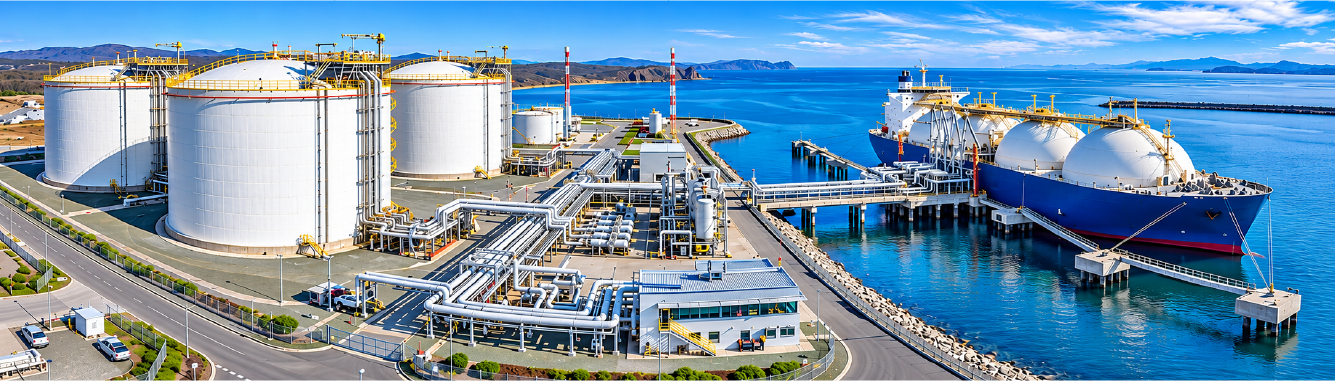
Oil and gas operations depend on interconnected assets operating across geographically distributed environments. Upstream facilities, offshore platforms, pipelines, processing plants, refineries and LNG terminals all generate different types of operational information.
This data supports critical decisions involving:
- Production performance and optimization.
- Equipment condition and reliability.
- Process safety and operational monitoring.
- Pipeline integrity and flow management.
- Refinery performance.
- Maintenance planning.
- Inventory and logistics coordination.
- Asset lifecycle management.
However, when information remains isolated within individual systems, organizations struggle to connect operational conditions with broader business objectives.
Cybersecurity: Protecting the Industrial Data Environment
Cybersecurity: Protecting the Industrial Data Environment
Connecting industrial systems creates new pathways through which information moves between operational networks, enterprise platforms, remote users and external services.
This makes cybersecurity an essential part of industrial data infrastructure design.
Oil and gas companies need to protect both the data environment and the operational systems that generate and use that data.
Key priorities include:
- Segmentation between IT and OT networks.
- Secure industrial gateways.
- Controlled remote access.
- Identity and access management.
- Network monitoring.
- Vulnerability and configuration management.
- Secure data transmission.
- Backup and recovery.
- Third-party access controls.
- Incident response planning.
The National Institute of Standards and Technology's NIST SP 800-82 Rev. 3 provides guidance on securing operational technology while accounting for its distinct performance, reliability and safety requirements.
For oil and gas organizations, this means cybersecurity controls must be designed around operational realities. Protecting data should never undermine the availability or safe operation of critical industrial processes.
Building the Data Foundation for Smarter Oil & Gas Operations
The future of digital operations will depend not only on the technologies companies deploy, but also on the strength of the infrastructure connecting them.
Building the Data Foundation for Smarter Oil & Gas Operations
The future of digital operations will depend not only on the technologies companies deploy, but also on the strength of the infrastructure connecting them.
Sensors and control systems generate operational information. Integration platforms connect previously isolated environments. Data historians and repositories preserve operational context. Edge and cloud technologies make information available for different types of applications. Governance and cybersecurity ensure that the resulting environment remains reliable and secure.
Together, these capabilities create the foundation for advanced analytics, predictive maintenance, digital twins and AI-driven operational decisions.
Oil and gas companies that invest in scalable industrial data infrastructure will be better positioned to connect their assets, improve operational visibility and turn information into measurable business value.
Smarter operations begin with a stronger data foundation.
Categories
Oil & Gas Digitalization