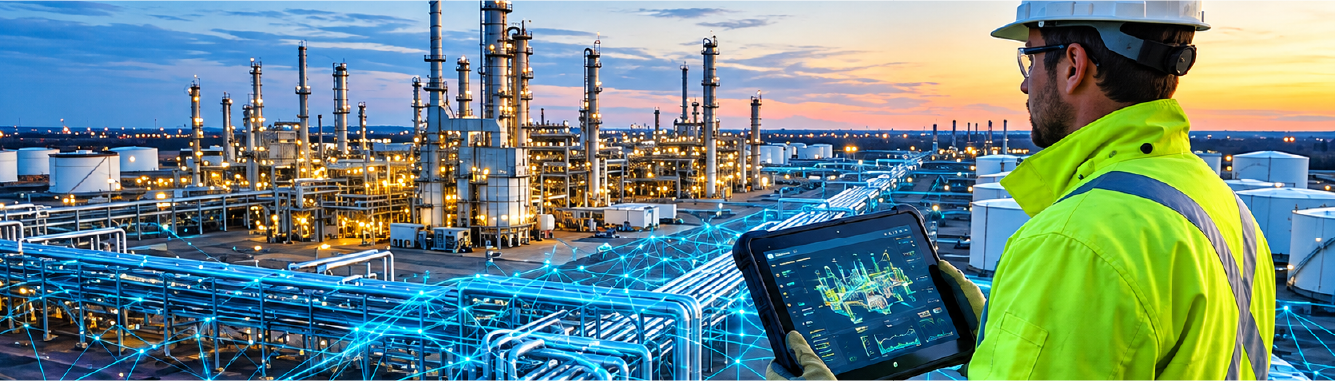
The oil and gas industry generates billions of operational data points every day from drilling rigs, production facilities, pipelines, refineries, LNG terminals, offshore platforms, sensors, historians, and enterprise applications. Yet despite having access to unprecedented volumes of information, many organizations still struggle to transform raw industrial data into timely operational intelligence. The challenge is no longer data collection - it is understanding the operational context behind the data and making it accessible across the enterprise.
Contextualized industrial data is becoming a critical foundation for smarter oil and gas operations. By connecting data to assets, equipment, locations, processes, maintenance history, production events, and business functions, organizations can create a unified operational view that supports faster decision-making, predictive analytics, artificial intelligence, and enterprise-wide collaboration.
As digital transformation accelerates across upstream, midstream, downstream, and LNG operations, contextualized data is enabling companies to move beyond disconnected dashboards toward intelligent operational ecosystems.
Why Context Is the Missing Layer in Industrial Data
Oil and gas organizations collect operational data from hundreds of different systems, each serving a specific operational purpose.
Typical data sources include:
-
SCADA systems.
-
Distributed Control Systems (DCS).
-
Industrial historians.
-
IoT sensors.
-
Enterprise Asset Management platforms.
-
Maintenance systems.
-
ERP applications.
-
Laboratory systems.
-
Production databases.
While these systems capture valuable operational information, they often use different formats, naming conventions, and asset identifiers. Without context, a pressure reading, vibration measurement, or flow value has limited operational meaning.
Contextualization connects every data point to the asset, equipment hierarchy, operating condition, process, and business event it represents, creating information that can be understood consistently across the organization.
Building a Connected Operational Data Foundation
Contextualized industrial data creates relationships between operational information rather than storing it in isolated systems.
This connected foundation links:
-
Physical assets.
-
Equipment hierarchies.
-
Sensors and measurements.
-
Maintenance activities.
-
Production events.
-
Engineering documentation.
-
Inspection records.
-
Business processes.
By establishing these relationships, organizations create a shared operational context that supports analytics, reporting, AI, and digital operations across multiple business functions.
Eliminating Data Silos Across Oil & Gas Operations
Disconnected operational systems remain one of the biggest barriers to enterprise-wide decision-making.
Contextualized data helps eliminate silos by connecting information across:
Upstream Operations
Well performance, drilling data, production equipment, artificial lift systems, and reservoir information become part of a connected operational model.
Midstream Operations
Pipeline integrity, compressor stations, flow monitoring, inspections, maintenance records, and transportation data are connected through a shared asset context.
Downstream Operations
Refineries connect process units, instrumentation, maintenance history, operational events, laboratory data, and production metrics into unified operational intelligence.
LNG Operations
Storage tanks, compressors, vaporizers, loading systems, cryogenic equipment, and operational measurements are contextualized across the terminal environment.
This enterprise-wide connectivity improves visibility across complex operational environments.
Operational Intelligence Begins With Contextualized Data
Operational intelligence depends on understanding relationships between data, assets, and operational conditions.
Contextualized industrial data supports:
-
Real-time operational monitoring.
-
Production optimization.
-
Equipment health monitoring.
-
Maintenance prioritization.
-
Operational risk identification.
-
Energy performance analysis.
-
Supply chain visibility.
-
Performance benchmarking.
Instead of viewing individual dashboards independently, operators gain a complete picture of operational performance across assets and facilities.
Supporting AI and Advanced Industrial Analytics
Artificial Intelligence performs significantly better when operational data includes business and engineering context.
Contextualized data enables AI applications such as:
-
Predictive maintenance.
-
Failure prediction.
-
Anomaly detection.
-
Root cause analysis.
-
Production forecasting.
-
Intelligent alarm management.
-
Process optimization.
-
Decision support systems.
AI models can understand not only sensor values but also the operational significance of those measurements, improving prediction quality and decision confidence.
Contextualized Data Powers Digital Twins
Digital twins require accurate relationships between physical assets, operational measurements, engineering information, and maintenance history.
Contextualized industrial data provides the structure required to build intelligent digital twins by connecting:
-
Physical equipment.
-
Engineering models.
-
Sensor data.
-
Operational history.
-
Maintenance activities.
-
Performance analytics.
This enables digital twins to simulate operational conditions, evaluate production scenarios, and support predictive decision-making throughout the asset lifecycle.
Improving Asset Performance Through Connected Data
Asset performance improves when operational, maintenance, and engineering data are connected within a common context.
Organizations can use contextualized data to:
-
Monitor asset health continuously.
-
Identify equipment degradation.
-
Optimize maintenance schedules.
-
Improve spare parts planning.
-
Reduce unplanned downtime.
-
Benchmark equipment performance.
-
Support reliability engineering.
Connected asset intelligence enables maintenance teams to prioritize interventions based on operational impact and equipment criticality.
Industrial Data Integration Across Enterprise Systems
Contextualization relies on integrating operational and enterprise systems into a unified data environment.
Important integrations include:
-
SCADA platforms.
-
DCS systems.
-
Industrial historians.
-
Enterprise Asset Management (EAM).
-
Computerized Maintenance Management Systems (CMMS).
-
ERP platforms.
-
Inspection systems.
-
Production management applications.
-
Cloud data platforms.
Rather than replacing existing systems, contextualization creates a layer that connects and standardizes operational information across them.
Data Governance Strengthens Operational Trust
Contextualized industrial data is only valuable when organizations trust its quality and consistency.
Strong governance includes:
-
Asset naming standards.
-
Metadata management.
-
Data ownership.
-
Data lineage.
-
Quality monitoring.
-
Access controls.
-
Version management.
-
Security policies.
Governance ensures that operational intelligence is built on trusted and reusable industrial data.
Challenges in Contextualizing Industrial Data
Building contextualized industrial data environments requires organizations to overcome several challenges.
Legacy Infrastructure
Older operational systems often use inconsistent naming structures and proprietary data formats.
Data Quality
Incomplete or inaccurate operational data can reduce the effectiveness of analytics and AI.
Organizational Alignment
Engineering, operations, maintenance, and IT teams often manage data differently.
Scalability
Large organizations may need to contextualize millions of operational data points across thousands of assets.
Cybersecurity
Connected operational data platforms require secure access controls across IT and OT environments.
A phased implementation strategy focused on high-value operational use cases often delivers the greatest long-term success.
The Future of Contextualized Industrial Data in Oil & Gas
Oil and gas companies are increasingly moving toward connected operational ecosystems where contextualized industrial data becomes the foundation for enterprise intelligence.
Future developments will likely include:
-
Industrial knowledge graphs.
-
AI-powered operational copilots.
-
Real-time contextual search.
-
Autonomous operational workflows.
-
Semantic industrial data models.
-
Enterprise digital operating centers.
-
Advanced operational intelligence platforms.
These technologies will help organizations transform operational data into continuously evolving business intelligence across the enterprise.
Turning Industrial Data Into Enterprise Operational Intelligence
Contextualized industrial data is changing how oil and gas organizations understand and use operational information. By connecting data with assets, processes, equipment, maintenance history, and business context, organizations can create smarter operational intelligence that supports faster decisions and more resilient operations.
For companies pursuing data-driven transformation, contextualization is becoming the bridge between raw industrial data and enterprise-wide operational value. It enables analytics, AI, digital twins, predictive maintenance, and integrated operations to operate from a trusted, connected data foundation.
As operational environments become more digital and interconnected, contextualized industrial data will remain one of the most important building blocks for the next generation of intelligent oil and gas operations.
Explore Data-Driven Oil & Gas Innovation
The Data Driven Oil & Gas Conference by PTN Events brings together Chief Data Officers, CIOs, digital transformation leaders, data architects, AI specialists, technology providers, and industry experts to discuss the future of industrial data, operational intelligence, analytics, cloud platforms, AI, digital twins, and enterprise data strategies.
Key discussion areas include contextualized industrial data, operational intelligence, AI, data governance, industrial analytics, semantic data models, digital operating centers, predictive maintenance, and enterprise-wide data integration.
Register for the conference: https://ptnevents.com/conferences/datadriven-oil-and-gas/register