North America's industrial decarbonization strategy is increasingly moving from individual carbon capture projects toward regional carbon management systems. Instead of requiring every industrial facility to develop its own complete capture, transportation, and storage infrastructure, the emerging hub model connects multiple emitters to shared CO₂ transportation networks and common storage or utilization facilities.
This approach is particularly relevant to regions with concentrated industrial activity, where refineries, petrochemical facilities, natural gas processing plants, power facilities, cement producers, and other large emitters can potentially share infrastructure. The U.S. Department of Energy has been supporting carbon management through programs covering carbon capture demonstrations, large-scale pilots, carbon storage, and regional direct air capture hubs.
The development of these hubs could fundamentally change the economics and scalability of carbon management across North America. Rather than treating carbon capture as an isolated facility-level technology, regional hubs create an interconnected infrastructure model capable of supporting multiple industrial users.
From Individual Projects to Regional Carbon Networks
Carbon capture projects have historically been designed around individual industrial facilities. While this approach can work for large emitters located close to suitable storage sites, it can become challenging for smaller facilities or companies that lack access to dedicated transportation and storage infrastructure.
A regional hub can connect:
-
Industrial capture facilities
-
CO₂ gathering networks
-
Compression facilities
-
CO₂ pipelines
-
Intermediate storage
-
Geological storage sites
-
Carbon utilization facilities
-
Monitoring and verification systems
This shared infrastructure model can reduce duplication and allow multiple industrial facilities to participate in carbon management without developing completely independent systems.
Research examining industrial clusters has similarly found that shared CO₂ pipeline infrastructure can reduce transportation costs compared with separate dedicated pipelines, particularly for smaller emitters.
Why Industrial Hubs Are Gaining Momentum
The attraction of the hub model is largely based on scale.
Industrial facilities frequently operate within geographic clusters where multiple companies produce concentrated CO₂ emissions. Building a common transportation and storage network can therefore create infrastructure that serves multiple facilities simultaneously.
Regional hubs can potentially provide:
-
Shared CO₂ transportation
-
Lower infrastructure duplication
-
Greater storage capacity utilization
-
Improved project scalability
-
Easier connection for smaller emitters
-
Greater investment opportunities
This creates a network effect: as additional emitters connect to the infrastructure, the value of the overall carbon management system can increase.
Building the CO₂ Transportation Infrastructure
One of the most important components of a regional carbon hub is the transportation network.
Captured CO₂ must generally be compressed and transported from emitting facilities to utilization or permanent storage locations. Depending on geography, transportation can involve pipelines, shipping, rail, or other modes.
For industrial clusters, CO₂ pipelines can provide the backbone of the network.
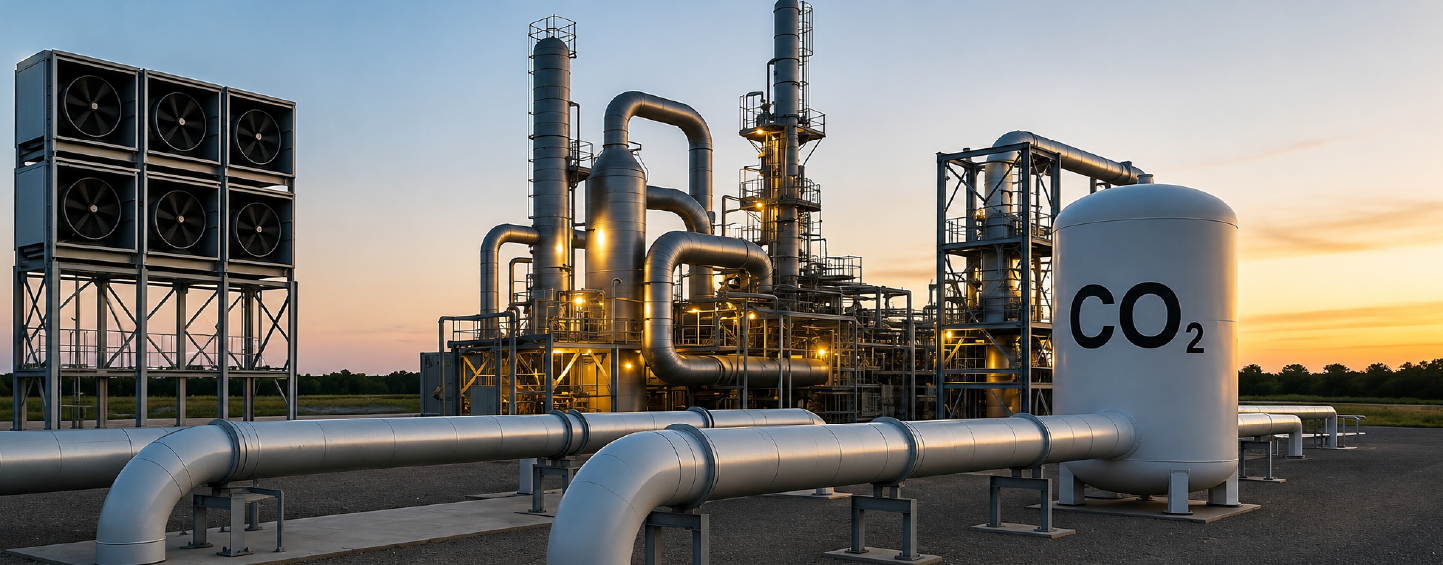
A regional pipeline system may include:
-
Collection pipelines
-
Trunk pipelines
-
Compression stations
-
Metering systems
-
Monitoring equipment
-
Storage injection connections
The design of these networks requires careful consideration of CO₂ volumes, pressure conditions, impurities, geography, storage capacity, and future expansion.
This means carbon management infrastructure needs to be planned as a long-term network, rather than simply as a collection of individual projects.
Connecting Industrial Emitters to Geological Storage
North America has significant geological storage potential, creating opportunities to connect industrial regions with suitable underground formations.
The hub model allows emitters to be geographically separated from storage sites while sharing transportation infrastructure.
This is particularly important because the locations of major industrial emissions do not always correspond with the locations offering the most suitable geological storage.
A successful hub therefore needs to coordinate three elements:
Capture → Transportation → Storage
If any one of these components is unavailable, the entire carbon management chain can face delays.
The Role of Carbon Storage Development
Permanent geological storage will be an important component of many carbon management hubs.
Storage development requires detailed evaluation of:
-
Geological formations
-
Storage capacity
-
Injectivity
-
Pressure management
-
Well design
-
Monitoring requirements
-
Long-term containment
The U.S. DOE's carbon management portfolio includes carbon storage validation and testing alongside carbon capture and transportation-related programs, reflecting the importance of developing the complete infrastructure chain rather than focusing solely on capture technology.
For hub developers, establishing reliable storage capacity early can therefore be critical to attracting industrial capture projects.
Digital Technologies Supporting Carbon Management Hubs
As regional networks become more complex, digital infrastructure will become increasingly important.
Operators can use digital technologies for:
-
CO₂ flow monitoring
-
Pipeline integrity management
-
Storage reservoir monitoring
-
Equipment performance analysis
-
Predictive maintenance
-
Emissions tracking
-
Digital permitting workflows
-
Remote asset monitoring
Advanced analytics can help operators understand how changes at one part of the network affect the broader system.
For example, variations in captured CO₂ volumes from multiple industrial facilities can influence pipeline utilization, compression requirements, and storage injection schedules.
Digital monitoring can therefore become an important tool for coordinating a geographically distributed carbon management network.
Creating Shared Infrastructure for Multiple Industries
One of the strongest advantages of the hub approach is its ability to connect different industrial sectors.
A single regional network could potentially serve:
-
Refineries
-
Petrochemical plants
-
Natural gas processing facilities
-
Cement plants
-
Steel facilities
-
Hydrogen production facilities
-
Power generation assets
-
Other large industrial emitters
This creates opportunities for infrastructure sharing and regional collaboration.
Instead of every facility developing its own CO₂ transportation and storage solution, a common network can provide access to carbon management infrastructure across an entire industrial cluster.
Investment and Commercial Opportunities
Developing regional carbon hubs creates opportunities for a wide range of participants.
Potential investment areas include:
-
CO₂ pipeline networks
-
Compression infrastructure
-
Geological storage
-
Capture technology
-
Monitoring systems
-
Storage wells
-
Carbon utilization
-
Digital infrastructure
-
Engineering and construction
-
Asset management
The emergence of shared infrastructure also creates opportunities for companies to operate carbon transportation and storage as infrastructure businesses rather than treating carbon management exclusively as an internal emissions-reduction project.
Regulatory and Community Considerations
Large-scale carbon management infrastructure also requires careful regulatory and stakeholder planning.
CO₂ pipelines, storage facilities, compression infrastructure, and industrial capture projects can cross multiple jurisdictions and involve numerous communities and landowners.
Successful development therefore depends on:
-
Regulatory coordination
-
Environmental assessment
-
Infrastructure permitting
-
Pipeline safety
-
Storage monitoring
-
Community engagement
-
Transparent project information
The DOE has previously emphasized stakeholder engagement and locally tailored technical assistance as part of efforts to advance regional carbon management deployment.
These considerations will remain important as hub developers move from individual feasibility studies toward large-scale infrastructure deployment.
Challenges to Scaling Regional Carbon Hubs
Despite their potential, carbon management hubs face significant challenges.
Infrastructure Scale
Large transportation networks require substantial upfront investment before enough emitters are connected to generate economies of scale.
Capture Economics
The cost of capturing CO₂ varies considerably by industrial process and emissions concentration. Projects involving dilute emissions can face greater economic challenges.
Storage Development
Storage sites require extensive geological characterization, permitting, monitoring, and infrastructure development.
Network Coordination
Multiple emitters, pipeline operators, storage developers, regulators, and technology providers must coordinate schedules and operating requirements.
Long-Term Commercial Models
Hub developers need predictable commercial arrangements that provide confidence for both emitters and infrastructure investors.
Addressing these challenges will determine how quickly regional carbon management systems can move from demonstration projects toward large-scale commercial infrastructure.
The Future of Industrial Carbon Management Hubs
The next generation of carbon management infrastructure is likely to become increasingly regional, interconnected, and multi-user.
Rather than building isolated carbon capture projects, industrial clusters can develop shared infrastructure that connects multiple emitters to common transportation and storage networks. This approach can potentially improve infrastructure utilization, reduce duplication, and make carbon management accessible to a broader range of industrial facilities.
North America's developing carbon management ecosystem is already moving toward this broader infrastructure concept, with federal programs supporting capture, storage, transportation, and regional hub development.
Over time, successful hubs could become major pieces of industrial infrastructure-similar in concept to existing pipeline, gas processing, and transportation networks - connecting industrial facilities to large-scale carbon storage resources.
The Road Ahead for North American Industrial Decarbonization
Carbon management hubs represent a shift from facility-level carbon capture to regional infrastructure planning.
Their success will depend on the ability to coordinate capture technologies, CO₂ transportation, geological storage, digital monitoring, financing, regulation, and industrial demand within a single connected ecosystem.
For oil and gas companies, refiners, petrochemical operators, infrastructure developers, EPC companies, technology providers, and investors, this creates a growing range of opportunities across the carbon management value chain.
As North America develops the infrastructure required for large-scale industrial carbon management, regional hubs could become an important mechanism for connecting industrial emissions with transportation and permanent storage—while creating new infrastructure markets across the continent.
Explore the Future of Industrial Transition
The North America Transition Summit by PTN Events brings together oil and gas companies, industrial operators, infrastructure developers, technology providers, EPC companies, investors, and industry leaders to examine the technologies, infrastructure strategies, and investment opportunities shaping North America's industrial transition.
Key areas include carbon capture, carbon management infrastructure, CO₂ transportation, geological storage, industrial decarbonization, hydrogen infrastructure, digital technologies, and large-scale industrial projects.
Register for the conference:
https://ptnevents.com/conferences/north-american-transition/register